A
couple of fellow blogger friends of mine have come down very hard on The
National’s latest album, Trouble Will Find Me. One described it as “dreary” and
asked the question, why bother? Another called it a “disgrace” and a “turgid
exercise in self-flagellation” ...
Harsh
words indeed.
The
New York based band’s sixth studio effort has certainly divided opinion so far,
and I note the popular Pitchfork site, on the other hand, was somewhat gushing
in its praise for the album, rating it a positively sizzling 8.4/10 and
including it in its ‘best new music’ category.
So
there are perhaps a couple of things worth considering in all of this.
The first is that The National haven’t done too
much differently on Trouble Will Find Me. What worked on Alligator, Boxer, and
High Violet (the band’s three most popular sets to date) tends to work just as
well on the new album.
Yet there may have been an expectation for The
National to come up with something novel, something exciting and fresh to stave
off the sort of critical backlash often reserved for mid-career bands. Onetime
‘next big thing’ type bands keeping faith with a formula that served so well
during formative years. Is there a school of thought dictating that The
National must now somehow move on?
The
second thing is that this band’s albums have always been slow creepers – the
sort of thing best appreciated after giving it time to really sink in.
Certainly, 2010’s High Violet was quite slow in revealing itself, and it took a
number of listens before it dawned on me what a beautifully constructed piece
of work it was. High Violet, for me, grew to become one of its year’s best
albums. The counter argument to such a notion, of course, is that a good album really
shouldn’t take that much work.
The National: great live rep, fading in the studio?
Trouble
Will Find Me, as it turns out, does feel like an exception to that rule. And curiously
enough, it grabbed me by the scruff of the neck right from the off. If there is
a major point of difference between past work and this album, that is it. This
one was instantly accessible. For me, obviously. For others, not quite so much.
There’s
parts where Matt Berninger’s silky baritone feels like it’s speaking directly
to me. And while this album’s set of lyrics don’t veer anywhere near as
dramatically between the severe self-loathing and extreme violence of its
predecessor, Trouble Will Find Me has an uneasy melancholy and dark beauty right
at its core. Berninger’s words have always had a capacity for surprise, and
with the odd dollop of humour thrown in, Trouble Will Find Me is every bit as quietly
mischievous as everything that preceded it.
The
band is faultless throughout, naturally; these guys are nothing if not thoroughly
professional. Arrangements are immaculate, and production ultra clean. Perhaps
that’s one of its problems? It almost feels a little too pristine, and if it’s
the spirit of raw rock n roll you’re looking for, then you definitely won’t
find it here.
And
I do actually get what others are on about. A lot of this does feel fairly
generic – there’s some truth in those claims. The band, while tight and polished,
could be accused of playing it safe, and there is a valid concern that The
National might be stagnating, switched to auto-pilot and merely going through
the motions.
Beyond
all of that however, I really do love this album (at the moment). I’m not sure
where it will ultimately rate alongside the rest of The National’s discography,
but despite its mixed reception, I’ve a very warm feeling that I’m only going
to keep on enjoying Trouble more and more as the year unfolds.
Highlights:
‘I Should Live In Salt’, ‘Demons’, ‘Don’t Swallow The Cap’, ‘Sea of Love’, ‘I
Need My Girl’, and the superb ‘Graceless’.
Atoms
For Peace is the current side project for Radiohead frontman Thom Yorke, and the
band includes talented friends like Radiohead producer Nigel Godrich, Red Hot
Chili Peppers bassist Flea, and sometime Beck and REM drummer Joey Waronker. Yorke
initially formed the group as a nameless live/touring act back around 2009, and
the long-time-in-coming debut album, Amok, says Yorke, was “the product of
getting together, getting wasted, and listening to Fela Kuti” ...
The
first couple of times I listened to Amok, it just sort of washed over me. It
felt a little bit inconsequential, like well produced background music, and it
barely registered at all. On first impression, the album was little more than a
blurry montage of glitchy twitchy sounds, with an ethereal Thom Yorke vocal
wailing indecipherably over the top. And while it had a persistent percussive
pulse underpinning the whole thing, there just didn’t appear to be all that
much substance beneath the exterior sheen.
Then
I heard it through headphones, and the album instantly took on a different hue.
The
intimacy of the headphone experience exposed a work of depth and detail that
wasn’t initially even hinted at. Rather than the distant distraction it first
appeared to be, Amok revealed itself to be a carefully crafted gem, an album
that draws heavily from elements of synthpop, electronica, and afrobeat to
create an almost perfect pop hybrid. And all of those minor details lost upon
the first couple of listens immediately became features ... highlights even.
That
shared love of afrobeat (and rhythm in general) shines brightly on Amok.
There’s a strong synth/electronic presence throughout, but mostly the music is
propelled by a nagging bass and multiple layers of percussion. The other major
player in the band is the Brazilian percussionist Mauro Refosco, and it is
Refosco’s best work that tends to stand out on an album that simply oozes
forward momentum.
It
all feels very polished (thanks, presumably, to Godrich), and in the end, even
Yorke’s occasionally annoying mumble-come-moan becomes a pivotal part of the
music. There’s a barely disguised simplicity about it, and perhaps even
something a little magical about the way vocal FX are employed on a couple of
tracks. Seldom has Thom Yorke’s voice proved more engaging over the full-length
course. While some of his fretwork isn’t half bad either.
When
Yorke released his first “solo” album, The Eraser, back in 2006, it continued
an electronica path Radiohead had already long been exploring, and as highly
rated as that album was by others at the time, I had huge difficulty separating
the work of Thom Yorke, the solo artist, from that of Radiohead, the band. But
that’s definitely not the case here. With Atoms For Peace, I’m somehow able to
get beyond the Radiohead thing, and for whatever reason, this band feels much
less a side project, and something way more rewarding in its own right.
Running
time is 44 minutes over the course of nine tracks, the best of which are: opener
‘Before Your Very Eyes’ (clip below), first single 'Default’, ‘Ingenue’, ‘Judge
Jury And Executioner’, and ‘Amok’.
Stand
up comedy might just about be the toughest gig in all of show business. If not
the toughest, then certainly the most unforgiving. Up there on stage in front
of hundreds of people expecting to be entertained by little more than what
comes out of your mouth. No chance of a last minute edit before it goes “live”,
and no chance to run and hide should things go a little awry.
But
the experienced Melbourne-based Irish comedian Jimeoin has seen it all before,
and he turned up at the Wellington Opera House last Sunday with his best game
face on, delivering an hour-long set that, due to its brevity, only left many
of those in attendance desperately wanting more.
I
get that it was a comedy festival gig, which are by their very nature
notoriously short, but I had expected a little more. Having seen Eddie Izzard
captivate a similarly sized audience for a much longer spell at the same venue
a few years back, I had hoped that Jimeoin’s set might stretch to around 90
minutes, or at the very least include an encore. Sadly, it wasn’t to be.
Jimeoin
is an engaging character with loads of charisma, but perhaps his best asset is
that “lived in” face. So much of his humour is supplemented by a look, a sly
glance, a knowing grin, a frown, or that moment where he tilts his head back
slightly and sniggers, as though the joke is somehow on the audience itself.
There’s
physical comedy (the gig kicks off with our man arriving on stage dancing to
some retro-chic disco, which is a bit like watching your boss at the annual
Christmas party), loads of observational humour about everyday little things,
jokes about (not telling) jokes, a lot of self deprecation, with morsels of
localised content thrown in every so often – the now almost obligatory mention
of Lord Of The Rings is becoming a little tiresome, truth be told (it reeks of
someone straining for local material and opting for the most obvious reference
point).
The
undoubted highlight was the section of the show near the end where Jimeoin dons
the guitar and offers some light musical relief. Not so much a set of “songs”,
rather, snippets of half-formed songs, or more accurately, a series of short
quips about songs. There’s some audience participation at this point, and
there’s no question that by the conclusion Jimeoin has offered more than enough
to win the audience over.
So
while it was some way short of the best comedy show I’ve seen, and certainly
one of the shortest (he could have perhaps done with a local up-and-comer
warming us up for 15 minutes or so), there is no question that Jimeoin is a
very funny guy, and yep, I’ll definitely look for another chance to see him
again.
Given
that Depeche Mode have been at the very heart of the synthpop scene for the
vast majority of my music listening lifetime (40 years), it was something of a
surprise to learn that Delta Machine is just the thirteenth full-length studio
release of the band’s career.
I
know Depeche Mode have not had their problems to seek over the years (health
issues, personnel changes etc) but I’d always thought of the group as one of the
most prolific of all the early Eighties pop survivalists. Apparently not, a
grand total of a baker’s dozen worth of albums over a span of 30 years offers us
a somewhat different perspective.
Part
of the reason, of course, that Depeche Mode have managed to remain at the
forefront of our collective consciousness throughout that period is to do with
the fact that so much of the band’s output has always been ripe for remixing;
seldom do we get just one released version of any given DM track. And I don’t
know how many different dance versions of ‘World In My Eyes’ or ‘Enjoy The
Silence’ I’ve heard over the years, but there’s been a few – most of them
pretty decent too. That, aligned with regular tours, has ensured the band’s
profile remains sufficiently high, and “new product” regularly available
regardless of whether or not the band have a new album out.
Over
the years I don’t believe I’ve come across any flop or “bad” DM albums, just
varying levels of “good”, ranging from mediocre to excellent, or in the case of
Violator, excellent verging on the truly exceptional. So perhaps another factor
in the band’s relatively light album output is the small matter of quality
control … they’re either perfectionists to the point of pedantry, or they
simply refuse to compromise, opting for craft (or should that be art?) over
timeliness. Or to put it another way – nothing ever feels too rushed.
My
download of Delta Machine is the deluxe edition; that means the standard
13-track album, and an extra “disc” of five additional tracks, including a second
and “live” studio version of the fair-to-middling lead single ‘Heaven’.
What
we get on Delta Machine is classic Depeche Mode – state-of-the-art production,
occasionally iffy songwriting, Gahan and Gore sharing vocals, and the requisite
number of a top drawer synthpop gems. And doubtlessly, plenty of source
material just waiting to be plucked for another round of remixing.
In
calling it “classic” however, I’m not necessarily saying it is one of DM’s
best, because in all honesty, it isn’t. It offers snippets of what the band
does best, crossing over into the murky waters of dark pop, without ever really
presenting us with a single moment, or track, where they truly nail it.
So
it’s classic in the sense that all of the band’s traditional boxes are ticked.
If anything, Delta Machine, much like its predecessor Sounds Of The Universe,
represents a return to older style elements of the band’s sound; a move away
from the harder edged guitar-infused stuff of a decade ago, with an evident
willingness to embrace synth-orientated pop first and foremost.
Not
bad for a bunch of old blokes …
Highlights:
the opener ‘Welcome To My World’, the single ‘Heaven’, ‘My Little Universe’, ‘Soothe
My Soul’, and from the bonus disc, ‘All That’s Mine’ (see clip).
May
is New Zealand Music Month. Celebrated by some, condemned by others, ignored by
the vast majority.
A
marketing ruse. A worshipping of false gods. Something akin to the heralding of
the world’s tallest pygmy.
Harsh?
… perhaps, but it’s fair to say that with each passing year,beyond the music industry itself, more than a
smattering of cynicism has started to creep in.
But
it’s also about acknowledging some good things too … some very good things. For
all of its flaws (of default and design), it does at least present us with an
excuse to reflect on a body of work that was, for the most part, denied a pre-internet
“rest of the world”.
On
that note, one of my favourite Enzed bands of the 80s (and beyond), The Clean, embracing
the lo-fi DIY ethic that made Flying Nun the “go to” label of the era … here’s ‘Anything
Could Happen’ (from 1981).
What
better way to conclude the Lost Alternative 80s series of posts.
I’ve been really impressed by this new release debut album
from Christchurch’s Salad Boys. It’s available as a name-yer-price download
from the band’s Bandcamp page. Get it here.
Recorded in Christchurch over the latter half of 2012, the
album feels like a genuine throwback to the Flying Nun glory days of the mid
Eighties, with the jangly guitar, bedsit-style vocals, and clever lyrics
immediately prompting recall of great bands like The Clean, The Bats, and The
Chills.
I note the band also made a cassette version available (a
limited edition of 75, at $5.00 each). To be fair, as this was a February release, I
suspect these will have all been snapped up by now, but that type of thinking
is kind of cool, and something that fits perfectly with the band’s
nostalgia-tinged modus operandi.
Highlights include: the instrumental opener ‘Eighteen Forty
Four’, ‘Daytime Television’ (very psychedelic clip below), ‘Here’s No Use’, and
‘Best Kept Secret’ ... and the eight-track album download is supplemented with
a pretty decent cover version of Wire’s ‘Strange’. Great stuff.
Salad Boys are: Joe Sampson - guitar, vocals, Ben Odering -
bass, and James Sullivan - drums. (Sullivan is also a member of the last young
Kiwi band to really impress me live – Bang Bang Eche – who I also raved about
here).
Salad Boys play live at Puppies bar in Wellington on April
20 2013 in support of (ironically enough) Mr Clean himself, David Kilgour. I’m
pretty sure they’ll be shit hot.
When
I learned recently of the uncertain future faced by popular Wellington venue/club
San Francisco Bath House (safety and compliance issues, followed by a sale), I
was immediately fearful that two of the most loved nights on Wellington’s social
calendar – and indeed, my own social calendar – would be at serious risk of
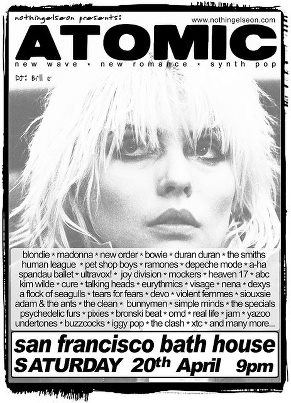
becoming extinct. I thought it timely then, to have a look at the SFBH’s ‘Atomic’
and ‘24-Hour Party People’ gigs, and the main man behind both bi-monthly
affairs, DJ Bill E.
Atomic
has, for the past decade or so, been the benchmark by which all other Alt-80s
nostalgia nights are measured. And 24-Hour Party People, with its 90s/post-millennium bent, captures a 30s-something market simply
not catered for by Courtenay Place’s trendy "clubs" and venues. The great music
on offer comes with the added bonus that neither night attracts the younger or more
feral hordes often associated with Wellington’s mainstream party strip.
Just
like its offbeat Cuba Street location, the San Francisco Bath House is known
for its sense of community, and there’s no question in my mind that the success
of both nights has been greatly enhanced because of that. I think it’s fair to
say that Atomic has earned the title of being Wellington’s longest ever running
“club gig” (prove me wrong), and that kind of accolade doesn’t come about by
accident.
Atomic
was started off in 1996 at the original Bar Bodega on Willis Street. It was a
pretty irregular gig to begin with, but after Bill E (or Bill Nothingelseon as
he is better known) returned from a three-year sabbatical in England in 2000, it
started becoming a regular fixture, firstly at the (relocated/new) Bar Bodega, before
moving to Indigo, which in turn became the San Fran Bath House. By 2003, 24-Hour
Party People had established itself as a genuine rival to its older sibling,
and the rest, as they say, is a little slice of local history.
If
I learned anything from reading ‘Last Night A DJ Saved My Life’ – Brewster
& Broughton’s comprehensive tome on the history of the DJ – recently, it’s
that the fine art of successfully moving the crowd can be loosely whittled down
to three key elements; having exquisite taste, having the vinyl to back it up,
and most importantly, possessing an inherent ability to read the crowd. If you
combine all three, other more peripheral factors become less critical … though
obviously, venue, sound, and technical aspects of the craft are all quite
important too. DJ Bill E brings all three key elements to the stage (literally), in spades. It’s
as simple as that.
I
was lucky enough to catch up with Bill recently – and naturally enough, my offer to
get him deliriously pissed next time I see him was sufficient for him to agree
to fill in a few square box shaped blanks for everythingsgonegreen …
If a time
machine could transport a 21-year-old Bill E to only one of the following
centres of pop culture excellence, where would he choose? … Merseyside in the
60s, New York in the 70s, or Manchester in the 80s?
Tough
choice! I'd probably have to plump for New York in the 70s - the combination of
disco, punk/new wave, no wave and the beginnings of hip-hop seal it, really.
Pretty grim times in all 3 places, none of them would have been much fun to
live through, though musically all were incredibly vibrant times. Much as I
would have loved to see The Smiths, let alone Joy Division, New Order through
to The Stone Roses and a whole bunch of other bands, the variety of what was
happening in New York takes it for me.
There's
an awesome documentary on New York in 1977:
Someone
has to write a song to save your life: Morrissey, Costello, or Weller?
My
heart says Morrissey, but my head would probably go for Costello - he's a
clever bugger.
The
dancefloor’s dying, you dig into the crate and pull out something produced by Martin
Hannett and something produced by Andy Weatherall … which guy do you opt for?
Depends
on the night and the vibe I guess, whichever feels right at the time. There's a
perfect fence sitting answer for you, though there's some interesting
similarities between the two - their use of space, dub elements, a certain
darkness. It could go either way and you probably wouldn't be disappointed.
There's a fabulous interview with Andy Weatherall on the Guardian music blog a
few weeks back which is well worth a listen. He's a totally top bloke.
How many
individual pieces of vinyl/black magic plastic do you own? (roughly is fine!)
3,178
all up as of today. That's 7", 10", 12" & LPs. I spent the
last couple of years on and off cataloguing it all on discogs.com, so you can
check it out here if you're interested:
It
was quite a labour intensive process but I'm glad it's done. It was nice to go
through all my records one by one.
(I
love Bill’s answer for that one. It makes me appear positively sane - Ed).
What are your
most listened to albums so far this year?
1.
Parquet Courts - Light Up Gold, 2.
David Bowie - The Next Day, 3.
Dexys - One Day I'm Going to Soar, 4.
No Tag - Live at the Windsor Castle, 5.
My Bloody Valentine - m.b.v., 6.
Husker Du - New Day Rising, 7.
Paul Kelly & The Messengers - Gossip, 8.
Johnny Foreigner - Johnny Foreigner vs Everything, 9.
Palma Violets - 180, 10.
The Wedding Present - Tommy
"not guilty yer honour"
Guilty
pleasure? (can be artist, album, or single track)
I'm
at the stage now where I don't feel too guilty about anything. I'm more than
partial to a bit of yacht rock or 70s singer songwriters, so I guess I've got
to go with Taylor Swift, there's a little guilt attached to that :-)
Top 5 Kiwi
desert island singles?
This
is hard! Can I have a top 100? As of this very moment it's this (in no
particular order):
Screaming
Meemees - See Me Go, Car
Crash Set - Fall From Grace, Danse
Macabre - Between The Lines, Home
Brew - Monday, The
Scavengers - True Love
But
ask me tomorrow and it'd probably be different.
New/current
artist we can’t afford to miss?
Johnny
Foreigner! From Birmingham, UK, they've been around since the mid 2000's. They
tick all the right boxes for me: 3 piece (now 4), make a racket, male/female
vocals, and they have tunes to spare.
Locally,
The Eversons - loved their album from last year, and really looking forward to
the next one.
What is
your funeral song?
The
cliched choice is probably Joy Division's Atmosphere, but it's pretty much
unimpeachable, so, that. For something a little more upbeat, The Undertones'
Teenage Kicks.
With the
future of SFBH currently unresolved, worst case scenario, where does Bill E go
from here?
I
guess the worst case is that I have to find somewhere else to play records.
Every year for about the last 5 years or so I've been saying that 'this year
will be the last', but it's never quite worked out that way, I enjoy it too
much. I have had one bar approach me to see if I'd be interested if things
don't work out at San Fran, and there's a few venues around where it could
work, so there are options. At the moment I have dates pencilled in for the
rest of the year now, I just have to wait and see what happens about the sale and
what the new owners want. I'll let you know :-)
The
next Atomic is this coming Saturday night, 20 April 2013 …
For the penultimate Lost Alternative 80s post, here’s The
Machinations, another Oz band, and yet another track from the glorious year
that was 1983. This one peaked just outside the Australian Top 20, but its
dancefloor-friendly groove propelled it into the US club charts. For years I
had great difficulty tracking down a decent vinyl version of this track ... um,
probably because for years I thought it was called ‘Precious Way’ ... here’s ‘Pressure
Sway’ ...
I’ve
just downloaded a (deluxe) copy of the brand new Depeche Mode album, Delta
Machine. I hope to have a review of that release up on everythingsgonegreen
sometime in the not too distant future. Meanwhile, in anticipation of that, I
thought I’d revisit a review I wrote a while back looking at arguably the band’s
finest moment: the Violator album of 1990 …
*
More
often than not considered little more than singles-orientated chart fodder for
much of the Eighties, the Depeche Mode brand was generally viewed as being
largely irrelevant by 1990. Broadly thought of (by then) as fairly one
dimensional and deeply unfashionable, synthpop had long since been closing in
on its own use-by date, and it was going to take something extra special for DM
to survive as a going concern heading into a brave new decade. And this time it
was going to take something rather more tangible than new haircuts for Messrs
Gahan, Gore, and co …
What
Depeche Mode came up with is Violator, an album now widely regarded as the
band’s masterpiece. Certainly it is the album most universally acknowledged as
the one that thrust the band beyond the realm of the singles charts, and into
the far more challenging and credible world of the album market. This was
achieved not by abandoning its core strengths (or those glossy synths), but by
developing upon them.
Violator
is the sound of a band arriving at the crossroads and embracing the task at
hand by adopting a darker, much harder edge to its trademark sound. Lyrically
too, DM seemed more assured than they’d ever been before, the tunes this time
around supplemented by a far stronger set of words than fans had been used to
on previous efforts. Although, it has to be said, there are a couple of
junctures on Violator still prone to induce the odd bout of cringing.
Even
the more casual observer will recognise this album's best moments – ‘Personal
Jesus’, ‘Enjoy The Silence’, and ‘World In My Eyes’ (to name only the most
obvious tracks) have all been remixed, reconfigured, and regurgitated in so
many different forms over the past two decades and that in itself is perhaps
the ultimate testimony to the quality and longevity of Violator. The original
versions as found on here remain just as essential, and along with ‘Policy Of
Truth’, ‘Halo’, and the rather ironic* ‘Clean’, they form the core of Violator,
and indeed all rate right up there as genuine synthpop classics.
(*ironic
mainly because – allegedly – Gahan himself was about to enter a prolonged
period of heroin addiction. I’ve seen it stated that ‘Clean’ is possibly about
something other than hard drug use, but I very much doubt it).
It
hardly comes as any great surprise that the release of Violator also coincided
with DM finally achieving a modicum of respectability in the US – specifically
as pre-eminent purveyors of dark pop within the still fledgling alt-goth genre.
And although it would take a couple of post-Violator full-length efforts to
really cement that status, this album essentially provided the coveted
breakthrough.
So
yep, Violator is quite probably the best Depeche Mode album of all, and
something of a major return to form at the time.
There’s
something distinctly 1983 about this clip from Oz rockers The Models. The
perfect blend of innocence, arrogance, and no little amount of hairspray. Although
‘I Hear Motion’ wasn’t the band’s biggest hit (see 1985’s ‘Out of Mind, Out of
Sight’) a version of it blew me away on the only occasion I saw the band live
in 1983, and the infectious Stevie Wonder-esque keyboard riff has been lodged
firmly in the cranium ever since. This clip features the band’s classic
line-up, including the late James Freud on bass, and ex-Palmerstonian Barton
Price on drums.

 The
New York based band’s sixth studio effort has certainly divided opinion so far,
and I note the popular Pitchfork site, on the other hand, was somewhat gushing
in its praise for the album, rating it a positively sizzling 8.4/10 and
including it in its ‘best new music’ category.
The
New York based band’s sixth studio effort has certainly divided opinion so far,
and I note the popular Pitchfork site, on the other hand, was somewhat gushing
in its praise for the album, rating it a positively sizzling 8.4/10 and
including it in its ‘best new music’ category.