I’ve been really impressed by this new release debut album
from Christchurch’s Salad Boys. It’s available as a name-yer-price download
from the band’s Bandcamp page. Get it here.
Recorded in Christchurch over the latter half of 2012, the
album feels like a genuine throwback to the Flying Nun glory days of the mid
Eighties, with the jangly guitar, bedsit-style vocals, and clever lyrics
immediately prompting recall of great bands like The Clean, The Bats, and The
Chills.
I note the band also made a cassette version available (a
limited edition of 75, at $5.00 each). To be fair, as this was a February release, I
suspect these will have all been snapped up by now, but that type of thinking
is kind of cool, and something that fits perfectly with the band’s
nostalgia-tinged modus operandi.
Highlights include: the instrumental opener ‘Eighteen Forty
Four’, ‘Daytime Television’ (very psychedelic clip below), ‘Here’s No Use’, and
‘Best Kept Secret’ ... and the eight-track album download is supplemented with
a pretty decent cover version of Wire’s ‘Strange’. Great stuff.
Salad Boys are: Joe Sampson - guitar, vocals, Ben Odering -
bass, and James Sullivan - drums. (Sullivan is also a member of the last young
Kiwi band to really impress me live – Bang Bang Eche – who I also raved about
here).
Salad Boys play live at Puppies bar in Wellington on April
20 2013 in support of (ironically enough) Mr Clean himself, David Kilgour. I’m
pretty sure they’ll be shit hot.
When
I learned recently of the uncertain future faced by popular Wellington venue/club
San Francisco Bath House (safety and compliance issues, followed by a sale), I
was immediately fearful that two of the most loved nights on Wellington’s social
calendar – and indeed, my own social calendar – would be at serious risk of
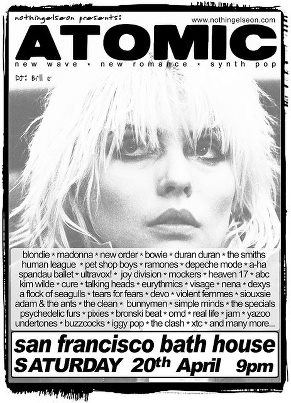
becoming extinct. I thought it timely then, to have a look at the SFBH’s ‘Atomic’
and ‘24-Hour Party People’ gigs, and the main man behind both bi-monthly
affairs, DJ Bill E.
Atomic
has, for the past decade or so, been the benchmark by which all other Alt-80s
nostalgia nights are measured. And 24-Hour Party People, with its 90s/post-millennium bent, captures a 30s-something market simply
not catered for by Courtenay Place’s trendy "clubs" and venues. The great music
on offer comes with the added bonus that neither night attracts the younger or more
feral hordes often associated with Wellington’s mainstream party strip.
Just
like its offbeat Cuba Street location, the San Francisco Bath House is known
for its sense of community, and there’s no question in my mind that the success
of both nights has been greatly enhanced because of that. I think it’s fair to
say that Atomic has earned the title of being Wellington’s longest ever running
“club gig” (prove me wrong), and that kind of accolade doesn’t come about by
accident.
Atomic
was started off in 1996 at the original Bar Bodega on Willis Street. It was a
pretty irregular gig to begin with, but after Bill E (or Bill Nothingelseon as
he is better known) returned from a three-year sabbatical in England in 2000, it
started becoming a regular fixture, firstly at the (relocated/new) Bar Bodega, before
moving to Indigo, which in turn became the San Fran Bath House. By 2003, 24-Hour
Party People had established itself as a genuine rival to its older sibling,
and the rest, as they say, is a little slice of local history.
If
I learned anything from reading ‘Last Night A DJ Saved My Life’ – Brewster
& Broughton’s comprehensive tome on the history of the DJ – recently, it’s
that the fine art of successfully moving the crowd can be loosely whittled down
to three key elements; having exquisite taste, having the vinyl to back it up,
and most importantly, possessing an inherent ability to read the crowd. If you
combine all three, other more peripheral factors become less critical … though
obviously, venue, sound, and technical aspects of the craft are all quite
important too. DJ Bill E brings all three key elements to the stage (literally), in spades. It’s
as simple as that.
I
was lucky enough to catch up with Bill recently – and naturally enough, my offer to
get him deliriously pissed next time I see him was sufficient for him to agree
to fill in a few square box shaped blanks for everythingsgonegreen …
If a time
machine could transport a 21-year-old Bill E to only one of the following
centres of pop culture excellence, where would he choose? … Merseyside in the
60s, New York in the 70s, or Manchester in the 80s?
Tough
choice! I'd probably have to plump for New York in the 70s - the combination of
disco, punk/new wave, no wave and the beginnings of hip-hop seal it, really.
Pretty grim times in all 3 places, none of them would have been much fun to
live through, though musically all were incredibly vibrant times. Much as I
would have loved to see The Smiths, let alone Joy Division, New Order through
to The Stone Roses and a whole bunch of other bands, the variety of what was
happening in New York takes it for me.
There's
an awesome documentary on New York in 1977:
Someone
has to write a song to save your life: Morrissey, Costello, or Weller?
My
heart says Morrissey, but my head would probably go for Costello - he's a
clever bugger.
The
dancefloor’s dying, you dig into the crate and pull out something produced by Martin
Hannett and something produced by Andy Weatherall … which guy do you opt for?
Depends
on the night and the vibe I guess, whichever feels right at the time. There's a
perfect fence sitting answer for you, though there's some interesting
similarities between the two - their use of space, dub elements, a certain
darkness. It could go either way and you probably wouldn't be disappointed.
There's a fabulous interview with Andy Weatherall on the Guardian music blog a
few weeks back which is well worth a listen. He's a totally top bloke.
How many
individual pieces of vinyl/black magic plastic do you own? (roughly is fine!)
3,178
all up as of today. That's 7", 10", 12" & LPs. I spent the
last couple of years on and off cataloguing it all on discogs.com, so you can
check it out here if you're interested:
It
was quite a labour intensive process but I'm glad it's done. It was nice to go
through all my records one by one.
(I
love Bill’s answer for that one. It makes me appear positively sane - Ed).
What are your
most listened to albums so far this year?
1.
Parquet Courts - Light Up Gold, 2.
David Bowie - The Next Day, 3.
Dexys - One Day I'm Going to Soar, 4.
No Tag - Live at the Windsor Castle, 5.
My Bloody Valentine - m.b.v., 6.
Husker Du - New Day Rising, 7.
Paul Kelly & The Messengers - Gossip, 8.
Johnny Foreigner - Johnny Foreigner vs Everything, 9.
Palma Violets - 180, 10.
The Wedding Present - Tommy
"not guilty yer honour"
Guilty
pleasure? (can be artist, album, or single track)
I'm
at the stage now where I don't feel too guilty about anything. I'm more than
partial to a bit of yacht rock or 70s singer songwriters, so I guess I've got
to go with Taylor Swift, there's a little guilt attached to that :-)
Top 5 Kiwi
desert island singles?
This
is hard! Can I have a top 100? As of this very moment it's this (in no
particular order):
Screaming
Meemees - See Me Go, Car
Crash Set - Fall From Grace, Danse
Macabre - Between The Lines, Home
Brew - Monday, The
Scavengers - True Love
But
ask me tomorrow and it'd probably be different.
New/current
artist we can’t afford to miss?
Johnny
Foreigner! From Birmingham, UK, they've been around since the mid 2000's. They
tick all the right boxes for me: 3 piece (now 4), make a racket, male/female
vocals, and they have tunes to spare.
Locally,
The Eversons - loved their album from last year, and really looking forward to
the next one.
What is
your funeral song?
The
cliched choice is probably Joy Division's Atmosphere, but it's pretty much
unimpeachable, so, that. For something a little more upbeat, The Undertones'
Teenage Kicks.
With the
future of SFBH currently unresolved, worst case scenario, where does Bill E go
from here?
I
guess the worst case is that I have to find somewhere else to play records.
Every year for about the last 5 years or so I've been saying that 'this year
will be the last', but it's never quite worked out that way, I enjoy it too
much. I have had one bar approach me to see if I'd be interested if things
don't work out at San Fran, and there's a few venues around where it could
work, so there are options. At the moment I have dates pencilled in for the
rest of the year now, I just have to wait and see what happens about the sale and
what the new owners want. I'll let you know :-)
The
next Atomic is this coming Saturday night, 20 April 2013 …
For the penultimate Lost Alternative 80s post, here’s The
Machinations, another Oz band, and yet another track from the glorious year
that was 1983. This one peaked just outside the Australian Top 20, but its
dancefloor-friendly groove propelled it into the US club charts. For years I
had great difficulty tracking down a decent vinyl version of this track ... um,
probably because for years I thought it was called ‘Precious Way’ ... here’s ‘Pressure
Sway’ ...
I’ve
just downloaded a (deluxe) copy of the brand new Depeche Mode album, Delta
Machine. I hope to have a review of that release up on everythingsgonegreen
sometime in the not too distant future. Meanwhile, in anticipation of that, I
thought I’d revisit a review I wrote a while back looking at arguably the band’s
finest moment: the Violator album of 1990 …
*
More
often than not considered little more than singles-orientated chart fodder for
much of the Eighties, the Depeche Mode brand was generally viewed as being
largely irrelevant by 1990. Broadly thought of (by then) as fairly one
dimensional and deeply unfashionable, synthpop had long since been closing in
on its own use-by date, and it was going to take something extra special for DM
to survive as a going concern heading into a brave new decade. And this time it
was going to take something rather more tangible than new haircuts for Messrs
Gahan, Gore, and co …
What
Depeche Mode came up with is Violator, an album now widely regarded as the
band’s masterpiece. Certainly it is the album most universally acknowledged as
the one that thrust the band beyond the realm of the singles charts, and into
the far more challenging and credible world of the album market. This was
achieved not by abandoning its core strengths (or those glossy synths), but by
developing upon them.
Violator
is the sound of a band arriving at the crossroads and embracing the task at
hand by adopting a darker, much harder edge to its trademark sound. Lyrically
too, DM seemed more assured than they’d ever been before, the tunes this time
around supplemented by a far stronger set of words than fans had been used to
on previous efforts. Although, it has to be said, there are a couple of
junctures on Violator still prone to induce the odd bout of cringing.
Even
the more casual observer will recognise this album's best moments – ‘Personal
Jesus’, ‘Enjoy The Silence’, and ‘World In My Eyes’ (to name only the most
obvious tracks) have all been remixed, reconfigured, and regurgitated in so
many different forms over the past two decades and that in itself is perhaps
the ultimate testimony to the quality and longevity of Violator. The original
versions as found on here remain just as essential, and along with ‘Policy Of
Truth’, ‘Halo’, and the rather ironic* ‘Clean’, they form the core of Violator,
and indeed all rate right up there as genuine synthpop classics.
(*ironic
mainly because – allegedly – Gahan himself was about to enter a prolonged
period of heroin addiction. I’ve seen it stated that ‘Clean’ is possibly about
something other than hard drug use, but I very much doubt it).
It
hardly comes as any great surprise that the release of Violator also coincided
with DM finally achieving a modicum of respectability in the US – specifically
as pre-eminent purveyors of dark pop within the still fledgling alt-goth genre.
And although it would take a couple of post-Violator full-length efforts to
really cement that status, this album essentially provided the coveted
breakthrough.
So
yep, Violator is quite probably the best Depeche Mode album of all, and
something of a major return to form at the time.
There’s
something distinctly 1983 about this clip from Oz rockers The Models. The
perfect blend of innocence, arrogance, and no little amount of hairspray. Although
‘I Hear Motion’ wasn’t the band’s biggest hit (see 1985’s ‘Out of Mind, Out of
Sight’) a version of it blew me away on the only occasion I saw the band live
in 1983, and the infectious Stevie Wonder-esque keyboard riff has been lodged
firmly in the cranium ever since. This clip features the band’s classic
line-up, including the late James Freud on bass, and ex-Palmerstonian Barton
Price on drums.
The
release of a brand new My Bloody Valentine album at the beginning of February
created quite a stir. More than 20 years after the much feted Loveless (1991)
was unleashed on an unsuspecting world we finally had the long promised
follow-up. The reaction was entirely predictable, and MBV fans across the
planet were once again able to indulge in a feeding frenzy of unrestrained
adulation. But does the album – simply titled mbv – match the hype?
Well,
I suppose I should start with a disclaimer: I’m not one of those fans. I quite
like the band’s 1988 debut album Isn’t Anything, but I’ve never been overly
passionate about Loveless, an album that seems to have taken on a life of its
own since the relatively humble (if not muted) response it received at the time
of its release.
And
when I say I “quite like” Isn’t Anything, what I actually mean is that I quite
like it as an album for a specific mood. Something to lose myself in when
things aren’t going especially well – it might even be regarded as an “angry place”
for me (layers of guitar, walls of feedback, best appreciated loud). Even at
that, for such a mood, there are dozens of other albums I’ll turn to before
Isn’t Anything.
So,
I’m probably not what you would call an avid My Bloody Valentine fan. Over the
years I’ve tended to regard the band (aka Kevin Shields, Bilinda Butcher, and
friends) as being somewhat one dimensional. What they do, they do well, but the
widely celebrated EPs and the two albums were more than enough. Did we really
need, some 20-plus years on, a third offering of what amounts to pretty much
the same thing again?
I
recall reading some years back about Shields and the ongoing struggle he faced
to produce an adequate follow-up to Loveless. From all accounts the man is a
sonic perfectionist who set the bar so high, the whole thing wound up becoming
impossible. Compromise, it seemed, was not a word he was familiar with. If it
wasn’t just right, it wasn’t going to see the light of day. His efforts to
replicate the “spirit” and energy of Loveless proved, um, fruitless. The band
broke up in 1996, with the album “three-quarters finished”, Shields got on with
his life, and that, we all thought, was that.
Then,
in 2007, out of nowhere, Shields announced that MBV had reformed. By 2008, the
band was very much in demand on the festival circuit; more often than not as headliners.
Which is quite odd really, when you stop to consider that back in the day the words
“My Bloody Valentine” were just as likely to have been found loitering amid the
bill’s fine print.
The
return as a live outfit was an obvious catalyst for Shields revisiting the
previously shelved material. He spoke candidly of the partially finished album
at the time ... “it just got dumped, but it was worth dumping. It was dead. It
hadn't got that spirit, that life in it” ... half a dozen years on, writing as
an observer – rather than as a fan – it is difficult to see what has changed.
Same old MBV
Certainly
there is nothing new to MBV’s approach on the new album ... layers of squalling
slightly out-of-tune guitar (check), blurred vocals (check), heavy on over-dubbing
and other assorted studio wizardry (check), and apart from one suspiciously
“pop” sounding tune (a track called ‘New You’, which features Butcher on
vocals), there’s very little on mbv that grabs me or excites me.
Popular
music website Pitchfork – while rating the album a positively gushing 9.1/10 –
made the following observation ... “through the 1990s Kevin Shields often
talked about jungle, what it meant to him, and how some of the ideas behind it
were making their way into a new (MBV) album. He was not alone in this, but
mixing drum'n'bass' whooshing walls of percussion with oceanic shoegaze seemed
a natural pairing” ...
Yet,
for me, none of that actually rings true. Those guys must be listening to a
different album. Those “ideas” aren’t immediately apparent on mbv. In terms of
“drum’n’bass” and any variation thereof, all I personally hear is a muddy drum
sound and a bass sometimes lost so deep in the mix as to render it almost
superfluous. Basically, I just don’t get it.
The
whole thing feels a little too heavily indebted to shoegaze’s early Nineties
heyday for my liking. That’s perhaps understandable, but nothing really
distinguishes it from past work, and if you ask me, this whole “new mbv” thing has
turned out to be something of an anti climax. I’m only thankful I didn’t have
any great expectations in the first place.
I’ll
probably end up giving it another couple of spins in attempt to uncover whatever
it is I’ve missed, but right now that doesn’t feel like an especially
appetising prospect. Right now I’m struggling to see what others see, and it
feels – as with Loveless – a little bit like I’ve been excluded from someone’s
special secret.
One
of the best things I’ve had on my pod over the past few weeks has been a great
little EP offering from Ruane.
“Ruane”
is Nick Roughan, ace sound engineer and producer, once of Palmerston North’s
very own Skeptics.
According
to the download’s blurb, the Ruane EP was conceived and created during
archiving sessions for a documentary on the Skeptics over the course of 2011
and 2012.
The EP is a well produced set of five quite melancholic instrumental/electronic
tracks. The mood feels a bit dark and challenging at times, but there’s a nice
ebb and flow about these compositions, and it’s a pretty rewarding listen
overall.
I’m
not really sure if Ruane will amount to anything more than this intriguing
one-off project, but Roughan has always been worth keeping a beady eye on, and this
is a quality name-yer-price download experience.
I
actually went to high school with (the then “Nicky”) Roughan, and although we
barely knew each other, my first encounter with the Skeptics, or an early incarnation
of the band, was a lunch hour gig, circa 1980, in the otherwise tranquil
surrounds of Palmerston North’s Awatapu College Library. I recall it because
never before had I encountered music quite so loud, raw, and experimental. The
concept of ‘industrial strength noise as intelligent art’ was not something I
was overly familiar with at the time.
I
saw the band a few more times over the next couple of years, at least once in that
hub of Palmy creativity otherwise known as Square Edge, it may have even been within
the confines of the band’s very own Snailclamps venue at the rear of that
building (it’s all a bit hazy), and possibly once or twice more in Wellington
during later years.
The
band’s wider local influence speaks for itself, and while cult status was
secured as a bewildering live act in the Eighties, the Skeptics’ longer term legacy
is best appreciated in the form of a number of highly coveted recordings, not
the least of which is the fine Amalgam album.
Vocalist
David D’Ath’s tragic death – due to that bastard we know and despise as
leukaemia – brought things to a sad close in 1990, but not before the Skeptics had
written their own special chapter in Kiwi underground rock music’s rich and
colourful history.
I’ll
leave you with this ‘Rocked The Nation’ clip which profiles the Skeptics’ most
controversial moment, the banned ‘AFFCO’ video. It features D’Ath on vocals, and
in the starring role, plus Roughan speaking near the end (despite being
incorrectly tagged in the clip as someone called Nick “Roughman”).
David
Bowie’s recent comeback album was a timely reminder of the relevance of an
artist who has had a profound influence on pop music throughout my lifetime. A
man who transcends the “three G’s” of music consumption: generation, genre, and
gender. I’ve got a fair few Bowie albums in my collection, the highpoint of
which is surely the 1972 landmark, The Rise and Fall of Ziggy Stardust and the
Spiders From Mars.
However,
I only have one compilation album in that set, the 1990 release ChangesBowie.
Not
to be confused with the 1976 “best of” album, ChangesOneBowie, or its inferior ill-fated
1981 companion release, ChangesTwoBowie, this one is something of a hybrid of
both. Indeed, it compiles the entire contents of ChangesOne, adds the essential
‘Heroes’, ‘Ashes To Ashes’, and ‘Fashion’, plus four singles from Bowie’s
mid-Eighties Serious Moonlight period including ‘Let’s Dance’ and ‘China Girl’. Subsequent
to 1990, of course, we’ve seen multiple David Bowie “best of” packages flood
the market, but ChangesBowie probably represents one of the more concise guides
to his more mainstream work, an ideal starting point for beginners, and
sufficient for the casual fan looking for an overview.
not this ..
.. or this
But
it’s not quite enough for me, and far from definitive. Comprising of just 18
tracks on a single CD, how could it be? That may seem more than enough for the
unfussy observer, but without even starting to scratch the surface, I can think
of at least another 18 tracks, right here and now, that could also have made
the cut – all pre-1990. The plain truth is, this album barely tells half the
story.
With
Bowie having revealed so many faces, and worn so many masks over the years,
somehow always managing to position himself on the periphery of the latest
trend, a single CD is never going to do Bowie’s career justice, and I’m afraid
that is all ChangesBowie ultimately amounts to.
Highlights
include the landmark ‘Space Oddity’, ‘Ziggy Stardust’, ‘Jean Genie’, ‘Rebel
Rebel’, ‘Golden Years’, ‘Heroes’, ‘Ashes To Ashes’, and ‘Fashion’ … but I’d
have preferred the original version of ‘Fame’ over the ‘Fame ‘90’ remix, and am
even less convinced by the disappointing ‘Modern Love’, and the simply awful
‘Blue Jean’.
Meanwhile,
the absence of ‘Starman’, ‘Sorrow’, and ‘Sound And Vision’ is unforgivable.
Here’s
an (imaginary) Alternative ChangesBowie compilation (hey indulge me!), to
include another 18 tracks NOT FOUND on here, all stuff that was out prior to
this album’s 1990 release date – picking up the best of the rest, whilst
carefully avoiding some of his earliest incarnations (‘Laughing Gnome’ anyone?)
and his worst commercial abominations (such as ‘Absolute Beginners’ and
‘Tonight’):
An
AlternativeChanges then: ‘The Man Who Sold The World’, ‘All The Young Dudes’,
‘Five Years’, ‘Moonage Daydream’, ‘RocknRoll Suicide’, ‘Starman’, ‘Life On
Mars’, ‘Station To Station’ (live), ‘Sorrow’, ‘Fame’ (the original please),
‘Sound And Vision’, ‘Wild Is The Wind’, ‘1984’, ‘DJ’, ‘Boys Keep Swinging’,
‘Under Pressure’ (with Queen), ‘Cat People’, and ‘This Is Not America’ (with
Pat Metheny);
Read
it and weep.
Here’s
David Bowie, class of 1977, performing ‘Heroes’ on Marc Bolan’s television show
… Bolan of course being a glam-era icon in his own right:
If
you read the UK music press – or rather, if you “believe” the UK music press –
you’d be convinced that David Bowie’s new album The Next Day was something akin
to a second coming. A few of the more hyperbolic sections of the media have
gone so far as to label it “the greatest comeback in Rock history”.
What’s
most fascinating about that, is that people still really care about David
Bowie. That pop music’s perennial chameleon is still capable of generating a serious
buzz, still up there as one of the big stories, and still provoking outrageous hyperbole.
At 66 years of age, no less.
Effectively,
that’s all that we’re celebrating here. It isn’t the greatest comeback in Rock
history. I’d be hard pressed to tell you what is, but The Next Day just isn’t
it.
For
all that it is in fact a terrific album by 2013 standards so far, it isn’t even
anything close to David Bowie’s very best work.
But
as we know, Bowie’s “very best” is a pretty high benchmark. One he’s been
struggling to achieve since the release of Scary Monsters back in 1980.
I
really enjoyed the fine Heathen album from around a decade ago, but Bowie for
me has always been the ultimate reference point for Seventies glam, androgynous
chic, and a cutting edge icon for a certain generation. And the truth is you have
to go back four decades to know Bowie in his prime.
Even
seeing him live at his commercial peak in 1983 felt anti-climatic for me, in
spite of the chart success he was enjoying at the time, his most creative years
had almost certainly been and gone.
There’s
been the odd flash of brilliance since, but after 2003’s Reality album and a
major health scare a year or so later, Bowie’s been more or less playing a new
role, that of quiet family man. Any new work would only be of curiosity value, and
little more than a bonus for collectors.
To
be fair, we’ve ended up with a quite a lot more than that – The Next Day proving
to be a very welcome, if entirely unexpected, addition to the vast (and mixed) Bowie
discography.
Rock God
The
album’s main strength is the sheer amount of variety on offer – from unrepentant
rockers (‘The Next Day’, ‘If You Can See Me’), to more straightforward pop
(‘The Stars Are Out Tonight’), to intriguing introspective numbers (‘Where Are
We Now’), and experimental slower ballads (the closer, ‘Heat’).
Bowie’s
voice has generally held up well, and if age has added a certain vulnerability
to it, there’s a sense that what he’s singing about is all the more believable simply
because he’s lived it. There’s moments where we experience a softer, less
imposing version of the man, and, gasp, times where Bowie seems almost happy to
be human again.
Lyrical
themes include war in the Middle East, religion, love, lust, the art of aging gracefully,
and more generally questions about how we’re continually managing to fuck
things up so irretrievably.
Inevitably,
the production is strong, and a major feature, just as you’d expect with long-time
Bowie cohort Tony Visconti back at the controls.
Bowie’s
standing as a Rock God can never be disputed and his influence across the last
four decades is there for all to marvel at, no dispute, but in a few years time
The Next Day won’t be recalled among his best half dozen or so albums, it just
won’t.
It
is however a wonderful belated footnote at the end of a long career, and the
album very probably includes, alongside stuff from 2002’s Heathen, some of his best
work in 30 years.
We’ve seen a number of New Order compilations released in
recent years, something that rightly and accurately reflects the enduring
popularity of a band that effectively peaked in the late Eighties. However,
whether it is a Best Of, a Rest Of, or a straightforward singles compilation,
none of them quite capture the true essence of New Order in the way that
Substance does. Released in 1987, this is the original compilation of hits
covering the first six years of the band’s existence. And how! As any fan of the band will tell you, New Order (or Factory)
weren’t big on the idea of including singles on the standard album releases at
first, so a number of these early tracks used to be quite hard to track down.
Which was a real shame, because some of that early stuff ranks right up there
with the band’s best work, and thankfully Substance addresses this in no
uncertain terms. Substance is a double CD set with (mostly or all?) 12”
versions of the band’s first dozen “singles” on the first CD, and all of the corresponding
B-sides on the second CD.
Such was the consistent quality of New Order’s output
it is difficult to rate one above the other, but the A-side CD probably just
shades it. As each is compiled in chronological release-date order, we get a
compelling insight as to how the band evolved from the ashes of Joy Division to
become crossover pioneers of the electronic dance music (soon to become
“Techno”) scene. Thoroughly recommended. 10 New Order Essentials: ‘Blue Monday’, ‘Temptation’ (clip below),
‘Everything’s Gone Green’, ‘Perfect Kiss’, ‘Ceremony’, ‘Subculture’, ‘Bizarre
Love Triangle’, ‘True Faith’, ‘Procession’, and ‘Thieves Like Us’.