Monday, August 22, 2016

Review: The Wellytown Get Down, Wellington Museum, 18 August 2016

I love a bit of nostalgia down here in the padded cell that doubles as the basement at the everythingsgonegreen mansion. Especially when it comes to celebrating all things local and grassroots. So when an event/gig with a focus on Wellington club culture in the Eighties comes along … well, let's just say things don't get much more near and dear to my heart, or indeed, more local or grassroots than that.

The event was called the Wellytown Get Down, and it took place last Thursday night at the unlikely but salubrious surrounds of the Wellington Museum on Queen's Wharf. It was essentially a chat-seminar-presentation put together by youthful next-gen hip hop aficionado/curator Sen Ski, featuring four genuine pioneers of the Wellington scene: past New Zealand DMC champs Rhys B and DJ Raw, plus ex Radio Active DJ Mark Cubey, and ex Soul Mine owner/event promoter, Tony Murdoch. What these four men (collectively) don’t know about the Wellington club/party scene in the Eighties, really isn’t worth knowing.


The idea was that each man would present, play, and discuss five records that they considered important to the era, with audience participation encouraged – that audience numbering roughly 80-100 by the time the event was in full flow. Sen Ski had clearly done his homework, and the backdrop to the stage – which housed a two-turntable rig/mixer – featured the projection of a series of images and video clips of the time, mostly specific to Wellington and those involved, but also some visuals offering wider scene-setting context (early break-dancing clips etc).

Murdoch was first to (re)present; his essentials being a mixture of hip hop and early house – see Digital Underground, Jungle Brothers, Eric B & Rakim, De La Soul et al – and he was thoroughly entertaining throughout, his knowledge shining through as he dispensed with facts and tidbits relating to each tune, and more generally providing an insider’s view of the dance music scene as it related to music retail and event promotion. Murdoch also paid tribute to two absent DJ’s who were also crucial to the Wellington scene – the now US-based pioneer Tony Pene (“TP”), and the prolifically talented but now sadly incapacitated Jason Harding (“Clinton Smiley”). Murdoch is a natural showman (he’d deny it) and during the course of his “set” was able to offer definitive proof that men can multi-task when he took a phone call (from his “homeboy”, who he urged to join us) while simultaneously continuing to present and play music. Remarkable.

Next up, Mark Cubey was equally entertaining, his angle being that of the student radio DJ – see Radio Active’s Uncut Funk Show and the Wednesday Night Jam – but he was also a genuine mover and shaker within the scene, as an event promoter, a club DJ, and (I’m pretty sure) as a performer in his own right as part of the wider Love Factory Band collective in the early Nineties. Cubey made the point that when he first started at Radio Active in the immediate post-punk era, the early to mid-Eighties, 90 percent of the music the station played was “white”. It was something he set about changing with the help of Pene, who became a fixture on the show, and Dr Johns nightclub, which was an early sponsor. Cubey talked a little bit about the influence of sampling, referencing the widespread use of Chic’s ‘Good Times’, and made mention of the important labels – like Sugar Hill, and Tommy Boy in particular. His selections covered off the Jonzun Crew, the Beastie Boys, and the seminal hip hop precursor ‘Adventures of Grandmaster Flash on the Wheels of Steel’.
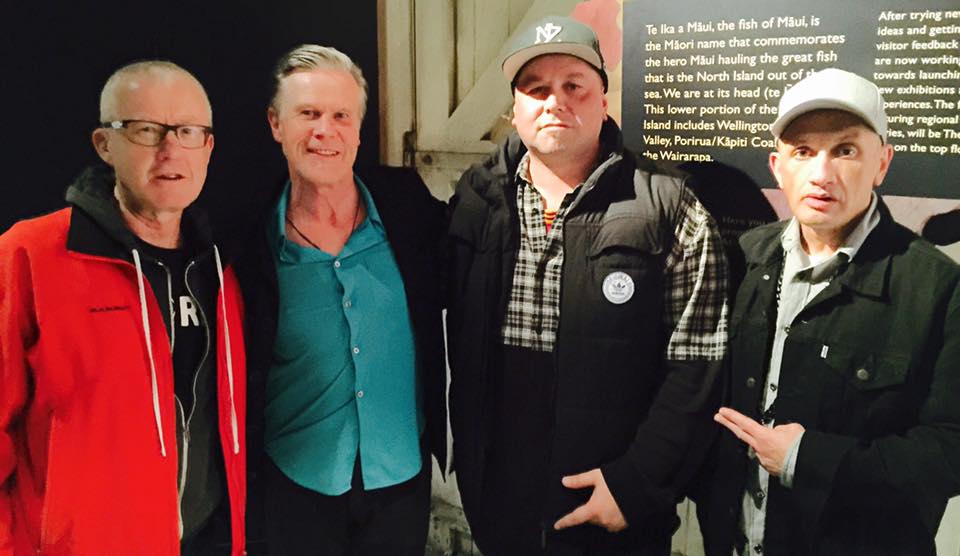
Funky 4: Cubey, Murdoch, Raw, Rhys B (credit: unknown/but thanks!)

I managed to have a quick chat with DJ Rhys B (Rhys Bell) prior to the event getting underway as I wanted to thank him personally for helping out with some photos for the AudioCulture piece I wrote a few years back, and he’s still the same earthy and modest guy he always was. I don’t think the current generation of DJ’s – beyond the likes of Sen Ski and perhaps one or two others who know the history – can really appreciate what a living legend he is within the context of Wellington and Aotearoa dance music circles. He is a pioneer DJ in so many ways, not just in terms of club and warehouse party culture, but as a performance DJ in a competitive environment, winning the first NZ DMC title before travelling to London in 1990 to represent Aotearoa at the World champs, where he finished a creditable 12th, and met the great hip hop icon Tupac, among other major industry identities. Rhys B talked primarily about what hip hop (specifically) means to him, about how it possibly saved him and a few others “from the gang scene”, about belt-drive turntables, and about the wider culture of the genre. His selections included music by the Fat Boys and Grandmaster Flash, and yes, it wasn’t until pushed by the audience that he revealed that Tupac connection.

Speaking of humble, DJ Raw (Ian Seumanu), was the final guest selector. Raw is another ex-NZ DMC champ and still very much involved in the scene, as head of the DJ programme at Whitireia Polytechnic and an active mentor for many others in “DJ Battle” circles. I don’t think any of the other presenters will mind me saying that this was very much a case of saving the best until last because Raw closed out the show with a compelling display of what is known as turntablism (or cutting and scratching to us mortals), putting on a show and getting the biggest cheer of the night. Prior to that Raw talked about growing up around older guys like Pene, and Rhys B, and attending clubs for the first time, about how he was influenced by the NME charts, the scene at the Soul Mine, and how getting access to rare early DMC footage on video had effectively changed his life. After being blown away by his closing party trick, I’m struggling to recall his earlier selections but I do know they included Shannon’s high energy ‘Let The Music Play’ and perhaps something from Full Force.

Regardless, whether you’re a nostalgia freak like me, a massive hip hop or dance music fan, or simply someone who loves music and/or local history, the Wellington Museum was a pretty damn fine place to be hanging out last Thursday night. Huge respect to Sen Ski for having the vision and wherewithal to piece it together, and thanks to the participants who took the time to tell their wholly unique stories. It might just have been the best couple of hours I’ve had all year.

Sunday, August 14, 2016

Waiting For Your Love

James Milne is a pretty big deal in New Zealand music circles. Currently making music under the Lawrence Arabia moniker, Milne has been at the forefront of the local indie scene for more than a decade, mostly in his (present) solo guise, but also as part of The Brunettes and as frontman for the short lived but much loved Reduction Agents. That’s without considering a touring stint with US indie darlings Okkervil River, or the many other side projects he's been involved with.

He is a man of many talents, and while the retro-dream-pop flourishes of Lawrence Arabia have quite rightly received plenty of plaudits over the past handful of years, I've always felt the Reduction Agents’ work never quite got the full attention it deserved. It might seem like a big call, but I reckon the solitary album, The Dance Reduction Agents (2006), might just be one of the best New Zealand full-length efforts of its decade.

So it was heartening to see this week, appearing somewhat out-of-the-ether on Bandcamp, a Reduction Agents tribute album featuring a few of the great and good of the local music scene – see Liam Finn, The Ruby Suns, Tiny Ruins, Salad Boys, The Eversons, The Beths, Princess Chelsea, and Instant Fantasy, among others – all lining up to pay homage, and to reinterpret that work.

The name-your-price download is called Waiting For Your Love, and you can grab it below:

Nice Enough

A few weeks back I sat down to chat with Rose Blake, Mike Isaacs, and Scott Maynard of Wellington-based alt-folkers Pales (for NZ Musician magazine):

Pales in NZ Musician: Nice Enough (click here)

Pales on Bandcamp (click here)

Even better, is this short clip on the band put together a few months back by The Wireless (with thanks and credit to Ezra Simons and Gussie Larkin):


Saturday, August 6, 2016

Classic Album Review: The Beatles – Sgt Pepper’s Lonely Hearts Club Band (1967)

For the first two decades following its 1967 release, a good number of commentators duly rated Sgt Pepper’s Lonely Hearts Club Band as not only a landmark work for The Beatles, but as something close to the “greatest album of all-time” … as though it’s actually even possible to evaluate such a thing – see various NME polls and magazine lists across several generations.

But time allows for reassessment, and some 50 years on from its release, we’re afforded a much wider screen perspective on just where Sgt Pepper might sit, and it’s probably fair to say the subsequent couple of decades have seen the album somewhat downgraded from its original untouchable status. 

There is no question that the album is a work of art – musically, conceptually, and within the overall context of its time. I don’t think it’s always fully appreciated how much The Beatles improved as a band after making the decision to stop touring and performing live in 1966. The Sgt Pepper album in many respects captures that new found sense of creativity and freedom, unburdened as the band undoubtedly was from the more immediate and intense pressure of performing before an adoring public on a regular basis.

Not having to worry about how the music would translate on stage or in a live environment threw up a raft of new sonic possibilities for the band. Musical ideas that an equally adventurous (producer) George Martin was also keen to explore further. In a way, the shackles had been released, and the music of The Beatles was evolving way beyond the short sharp three-minute bursts of pop perfection it had relied so heavily on in the past.

Yet, curiously, it’s rarely an album I can play in its entirety without resorting to skipping the odd track. Despite the presence of some real gems, it feels a little patchy, or almost as though there’s actually too much going on in places. A side effect, a downside, or a problematic consequence of that level of experimentation, perhaps. I remain a fan of the album, and I’m not denying it showcases a remarkable amount of sheer genius, but I’m also pretty sure that it’s not even the best Beatles album out there (see Revolver), let alone the greatest of all-time.

Many tracks have endured to become classic rock standards: ‘With A Little Help From My Friends’, ‘Lucy In The Sky With Diamonds’ and the masterful ‘A Day In The Life’ (clip below), in particular. But generally the album is fleshed out with quirky novelty cuts – I’ll stop short of calling it “filler” because this is The Beatles after all – with the likes of ‘Lovely Rita’, ‘When I’m Sixty Four’, and ‘Being For The Benefit Of Mr Kite’ all unlikely to have made much sense beyond the context of this album.

I also think Sgt Pepper could have been improved by the inclusion of ‘Strawberry Fields’, the superb single of the same year, a song that embraced the flower power counter-culture ethos of 1967 quite unlike any other, one that wound up on the less celebrated Magical Mystery Tour release.

Nonetheless it remains an excellent album, a collectable, and a genuine timepiece … even if it’s not quite the unsurpassed piece of work it was once considered to be.


Tuesday, August 2, 2016

Album Review: Lucid Hiest - Absence In Motion (2016)

This was another review for the Fresh Cuts section of the latest issue of NZ Musician magazine:

http://www.nzmusician.com/2016/07/30/lucid-hiest-absence-motion/

(With this one I initially had OCD/spelling nazi issues with what I (wrongly) assumed was an incorrect spelling of the word Hiest (sic), and I also struggled with a few swearies on the album itself. Then I realised that Lucid Hiest couldn't care less about what the likes of me think, and it's exactly that attitude that makes the album the unique and special thing it is ...)

Self-proclaimed “East Coast rebel” Isiah Ngawaka knows a fair bit about life’s struggles. On Absence In Motion, wearing his Lucid Hiest moniker, Ngawaka gets to share a few of his stories, with a further promise that he’s really only just getting started. And when a young artist with this much talent starts out with roughly 50 tracks, whittling them down to an album-sized baker’s dozen becomes an exercise in continually raising the level on the quality control filter. The end result is a quite startling home-produced album which blends a distinctly local hip hop vibe with world-class drum’n bass flavours. Throw in sub-rattling slabs of heavyweight bass, a sack full of sticky dub, some smooth RnB vocal harmonies, plus the occasional post-apocalyptic sci fi sample, and Lucid Hiest covers off all of the bases within the gamut of this wider thing called ‘urban’. Themes include growing up in small-town Aotearoa, nights out, racism, and survival – within the music industry and with daily life itself. As fiercely independent as he undoubtedly is, Lucid Hiest gets some help along the way, mostly with vocals, but also from ace brass man Matt Mear, whose subtle instrumentation is one of the best features on an album rich in atmosphere. Something which is perhaps best emphasised on the outstanding ‘Pushing Through’. The explicit nature of some of the lyrics won’t appeal to all, but thankfully Ngawaka isn’t in this game to tread carefully on the delicate sensibilities of anyone not inhabiting his world. Lucid Hiest is all about creating four to five-minute bursts of gritty realism; these are his stories, honest and raw snapshots of his world, nobody else can tell him how to frame them. Bring on chapter two.

Saturday, July 30, 2016

Circuit Bent

In anticipation of a new album, Pitch Black have released another advance taster on Bandcamp, a track called ‘Circuit Bent’, state-of-the-art electro dub featuring words and vocals from Alison Evelyn. It’s a timely reminder of just what we can expect from Messrs Free and Hodgson ahead of their upcoming full-length offering, and they’ve made this one a free download for a limited time. Stream or download below.

Saturday, July 23, 2016

Album Review: Shades - For The Sake Of Experimentation (2016)

Released a month ago as a name-your-price deal on Bandcamp, For The Sake Of Experimentation is a six-track EP from a duo called Shades. Not to be confused with the Melbourne-based artist of the same name, these guys, according to their brief and rather modest bio on Bandcamp, are “two dudes from New Zealand”. As self-produced self-released debut EP’s go, this one is exceptionally polished, and I'm a little surprised it hasn’t yet gained a little more commercial traction. Then again, Gavin Woodward and Nick Wrathall, who work out of Auckland and Wellington respectively, are only just starting out, and their beautifully crafted intoxicating blend of dreamy pop hasn't yet caught the ear of the wider public. Brief excursions into the realm of hip hop aside, there's something distinctly "yacht rock" about these tunes, and with its breezy production sheen, the EP appeals as something of a throwback to a bygone era of plush radio-friendly pop. There’s four songs on For The Sake Of Experimentation, but actually six tracks, with ‘Soundless Speed’ working as a short intro at just over a minute long, and we get two versions of a tune called ‘Shapeless’, with a rework by Yume acting as the EP closer. I’m a bit reluctant to single out highlights, but both ‘Slow Down’ and ‘Summer Spent’ probably fit the bill. Stream or download from the link below, or check out the same work on the Shades Soundcloud page


Thursday, July 14, 2016

Album Review: Shady Brain Farm - Feather In A Fire (2016)

This review was originally written for publication in the Fresh Cuts section of the June/July 2016 edition of NZ Musician magazine …

http://www.nzmusician.com/2016/07/14/shady-brain-farm-feather-fire/

First things first, the CD packaging for Feather In A Fire, the latest release for the ominously named Shady Brain Farm, is truly impressive. Not only in its cover design, which is an unusual concoction of acid-tinged pop art and freaky monster imagery, but also in a wider sense, with a double-sided band poster inlay adding an immediate connection with our subjects. The Auckland three-piece’s music is less easy to categorise, with the 12-track album throwing up a genuine hybrid of styles and influences – from ska and cod reggae, to power pop, to what can only be described as some form of arty psychedelic surf rock. And often, it feels like the flit between genres is only the clever flick of an FX pedal away for guitarist and vocalist Ben Furniss. Yet it’s likely this artistic ambiguity is a deliberate ploy, a firm if unspoken modus operandi, and if variety really is the spice of this thing called life, then here is a colourful upsized carton of tasty soul food. It’s that freedom from any stylistic prejudice, and the refusal to be easily labelled, which is perhaps the album’s biggest strength.

Wednesday, July 13, 2016

Album Review: Broods - Conscious (2016)

Nah, I'm not sure why I've got this one either. Apart from it being another local release I couldn't let slip past. Which is kind of silly, because I didn't really expect to enjoy it. Let's call it an OCD thing and move on. I'm not really the target demographic for Broods, and I'm pretty sure Broods' music has a pretty specific target demographic.

So I'll try to be brief: this is a distinctly 2016 brand of synthpop, full of soft emo-tugging hooks and similarly persuasive production tricks. Cutesy colour-by-numbers electronic pop, immaculately produced - naturally - by Lorde collaborator Joel Little.

It isn't that siblings Georgia and Caleb Nott aren't talented, or not very good at what they do, because they are. It's just that the music they make doesn't really speak to me on any level other than a very superficial one.

Which in itself isn't always an issue either. I actually quite like similarly teen-geared stuff from local youngsters like Lontalius and Boy Wulf. It's just that for all of those pop hooks, Conscious feels very safe and a little too bland for my taste. It lacks innovation beyond a well-worn formula, and its intended inoffensiveness is actually a little offensive to me. It doesn't challenge me in any way whatsoever. But then, I never really expected it would.

For all of that, despite my cynicism, on a commercial level, with Conscious, Broods have successfully negotiated the often tricky album number two. It was flying high in the album charts when I last checked, and my opinion of it makes no odds one way or another. The duo's path is well set.
 
But, with synthpop being the super fickle genre it undoubtedly is, they may want to think about mixing it up or pushing a few more boundaries next time out. That’s all I’m going to say ...

Sunday, July 10, 2016

Album Review: Various/Sherwood at the Controls Volume 2 1985 - 1990 (2016)

I ordered the CD/T-shirt bundle for this release as long ago as March (a pre-order for a June release), so my excitement when the package turned up in my letterbox last week was palpable. I may be a grizzled middle-aged man, but my inherent ability to revert back to "kid in a sweet shop" mode right on cue really is quite remarkable at times.

Of course, that's really just another way of saying that anyone hoping for a balanced or objective review of the latest On-U Sound compilation release will probably be best served going to another site.

The second volume of Adrian Sherwood's At The Controls series showcases a selection of the On-U label's extensive archives from the period 1985 to 1990. It's a follow-up to last year's impressive first instalment, which featured producer/label guru Sherwood's work from 1979 to 1984. More generally this release covers what was arguably Sherwood's most productive period, and highlights the man's uncanny ability to sprinkle fairy dust across a variety of different musical genres.

As such, hard-edged industrial post-punk electronica from the likes of Mark Stewart ('Hypnotised' 12-inch) and KMFDM ('Don't Blow Your Top') sits comfortably alongside the heavy funk beats of Tackhead ('Mind At The End Of The Tether') and Doug Wimbish & Fats Comet ('Don't Forget That Beat').

Naturally there's the obligatory helping of dub (roots/reggae and electro) with tunes from Lee Perry ('Music & Science Madness'), Bim Sherman (a stripped back dub version of 'Haunting Ground'), African Head Charge ('Hold Some'), plus a couple of tracks from label stalwarts Dub Syndicate ... although one of those is little more than a short interlude, effectively paying tribute to label legend Style Scott, R.I.P.

Other highlights include the so-very-Eighties politically-charged early hip hop of The Beatnigs with 'Television' ("it's the drug of the nation"), which features a pre-Spearhead Michael Franti. There’s a genuine synthpop relic from pre-hard industrial era (read: pre-heroin) Ministry with 'All Day', and Pankow's completely bent but still wonderful take on Prince's 'Girls And Boys'.

Contributions from Tackhead drummer and frequent co-conspirator Keith Le Blanc, ex-anarcho-punks Flux, Afro-German outfit The Unknown Cases, plus the otherwise little known Italians, Rinf, take the track-listing up to a generous 16 cuts in total - or just over 72 minutes of listening pleasure all up.

And yet, despite the wide variety of artists and styles merged together for this compilation - as with the first volume - nothing feels out of place. Every track is drenched in Sherwood signature moments - be it his absolute understanding and mastery of space through the use of echo FX or reverb, be it the careful placement of a politically-motivated sample or three, or be it some other odd sound-shape or subtle bass drop just when it's least expected. This is Sherwood at the controls, as uncompromising as always, and operating at something of a career peak.

Finally, the quality of the liner notes - not always an On-U label strength - was a nice surprise. The CD release comes with a booklet containing a very comprehensive set of notes, which provide some of the best commentary I've yet read about this remarkable label. There's a good selection of rarely seen photos - including one of a young Sherwood, with hair.

Oh, and I love the Tee, black with the album cover design, even if it is somewhat tighter fitting than I had anticipated it would be … three months clearly being an unruly length of time in the life of your blogger's ever expanding waistline.

I can hardly wait for the next volume already. Make mine an XL.

Here’s Tackhead’s ‘Mind at The End of The Tether’ ...